

A drafty window doesn’t always mean you need to replace it. Knowing how to stop window drafts is one of the most practical things a Canadian homeowner can learn before winter, and most of the time it costs under $50 and takes less than an hour. Before you call anyone about window replacement in Toronto or Winnipeg, spend 20 minutes finding out where the air is actually coming from.
I’ve done hundreds of energy retrofits across Winnipeg and Calgary over 22 years, and I’d say at least half the “replace the window” calls I’ve been brought in on turned out to be a weatherstripping or caulking problem. The window was fine. The fix was $20 at a hardware store.

How to Find Window Drafts (the 3-step test)
Don’t guess. Use one of these three diagnostic methods to pinpoint the source before you buy anything.
The candle test: Hold a lit candle or incense stick about 25mm from the window perimeter on a cold, windy day. Work slowly around the frame edge, the sash perimeter, and the glass edge. Any flame movement or smoke deflection shows you where air is infiltrating.
The hand test: On a cold day with the wind blowing, move your hand slowly along the window frame and glass. Your hand is sensitive enough to feel a small temperature difference where cold air is leaking in. Not as precise as the candle test, but you don’t need to buy anything.
The paper test: Close the window on a sheet of paper. Try to slide the paper out. If it slides easily with no resistance, the window isn’t sealing at that point. Try this at several positions around the sash perimeter.

How to Find and Fix a Window Draft in Under an Hour
6-step draft fix process
Gather your tools
You need a candle or incense stick, V-strip weatherstripping, exterior-grade caulk, a utility knife, and a caulk gun. Total cost at a hardware store: $20 to $40.
Run the candle test
On a cold windy day, hold a lit candle or incense stick 25mm from the window perimeter while someone else walks around the exterior. Watch the flame or smoke. Movement means air is moving.
Identify the source
Note exactly where the flame moves. Frame-to-wall junction means caulking. Sash perimeter (where the opener meets the frame) means weatherstripping. Glass edge means glazing compound or IGU failure.
Apply weatherstripping if it’s the sash seal
Remove the old weatherstripping completely. Clean the channel with a dry cloth. Cut V-strip to length and press it firmly into the channel. Close the window and check the seal by trying to pull a sheet of paper out from between sash and frame.
Apply caulk if it’s the frame-to-wall junction
Cut the old caulk out with a utility knife. Clean the surface. Apply a bead of siliconized latex (interior) or silicone (exterior) caulk in one continuous pass. Smooth with a wet finger. Let cure 24 hours before painting.
Re-test
Repeat the candle test. If the flame is still moving, you’ve got another source to find. Work around the entire window perimeter before declaring it fixed.
The Four Most Common Sources of Window Drafts
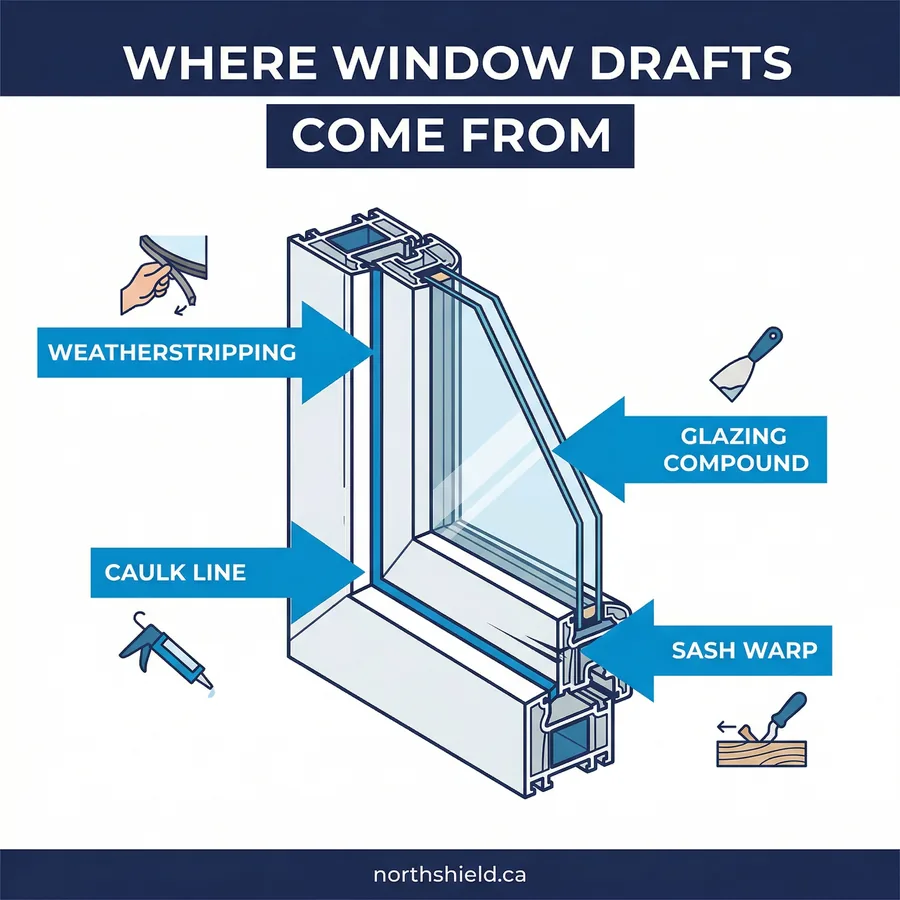
In my experience, 95% of window drafts come from one of these four places. Check them in order before assuming you need a new window.
1. Worn weatherstripping on operable windows
This is the most common culprit on casement windows, double-hung windows, and sliding patio doors. The weatherstripping around the sash perimeter compresses every time you close the window. Over 10 to 15 years, it flattens out or deteriorates and stops sealing.
Signs to look for: a visible gap when the window is closed, foam or felt strip that’s compressed flat and doesn’t spring back, or missing strips on one side of the sash.
2. Failed caulking between frame and wall
The caulk line where the window frame meets the wall sheathing gets direct weather exposure. In Canadian climates, even good caulk starts to crack and separate after 5 to 10 years. Check the exterior of every window frame at the junction with the siding or brick. Hairline cracks are enough to let air through.
3. Cracked or shrunken glazing compound
On older wood-frame windows, the putty (glazing compound) around the glass pane shrinks and cracks over time. This opens a gap between the glass and the frame. You can re-glaze a window yourself with fresh glazing compound from a hardware store — it’s a legitimate repair that extends the window’s life significantly.
4. Warped sash that doesn’t close flat
Wood window sashes warp. Vinyl sashes can warp too if they’re low quality or if they weren’t installed correctly. A sash that doesn’t close flat against the frame will never seal properly regardless of how good the weatherstripping is. This one sometimes requires professional adjustment or sash replacement.
Weatherstripping: How to Choose and Replace It
There are four main types of weatherstripping. For most windows, V-strip is the best choice.
V-strip (tension seal): A folded metal or plastic strip that fits into the sash channel and springs against the surface to create a seal. Lasts 10 to 20 years. Works on sliding windows and double-hung windows. This is what I install on every energy retrofit.
Foam tape: Self-adhesive closed-cell foam. Easy to apply, but compresses permanently within a few seasons. Good for a seasonal fix or for windows that don’t get opened often. Costs $3 to $8 per roll.
Compression strip (door stop style): A rubber or silicone bulb strip that compresses when the window closes against it. Works well on hinged casement windows where the sash closes against the frame stop.
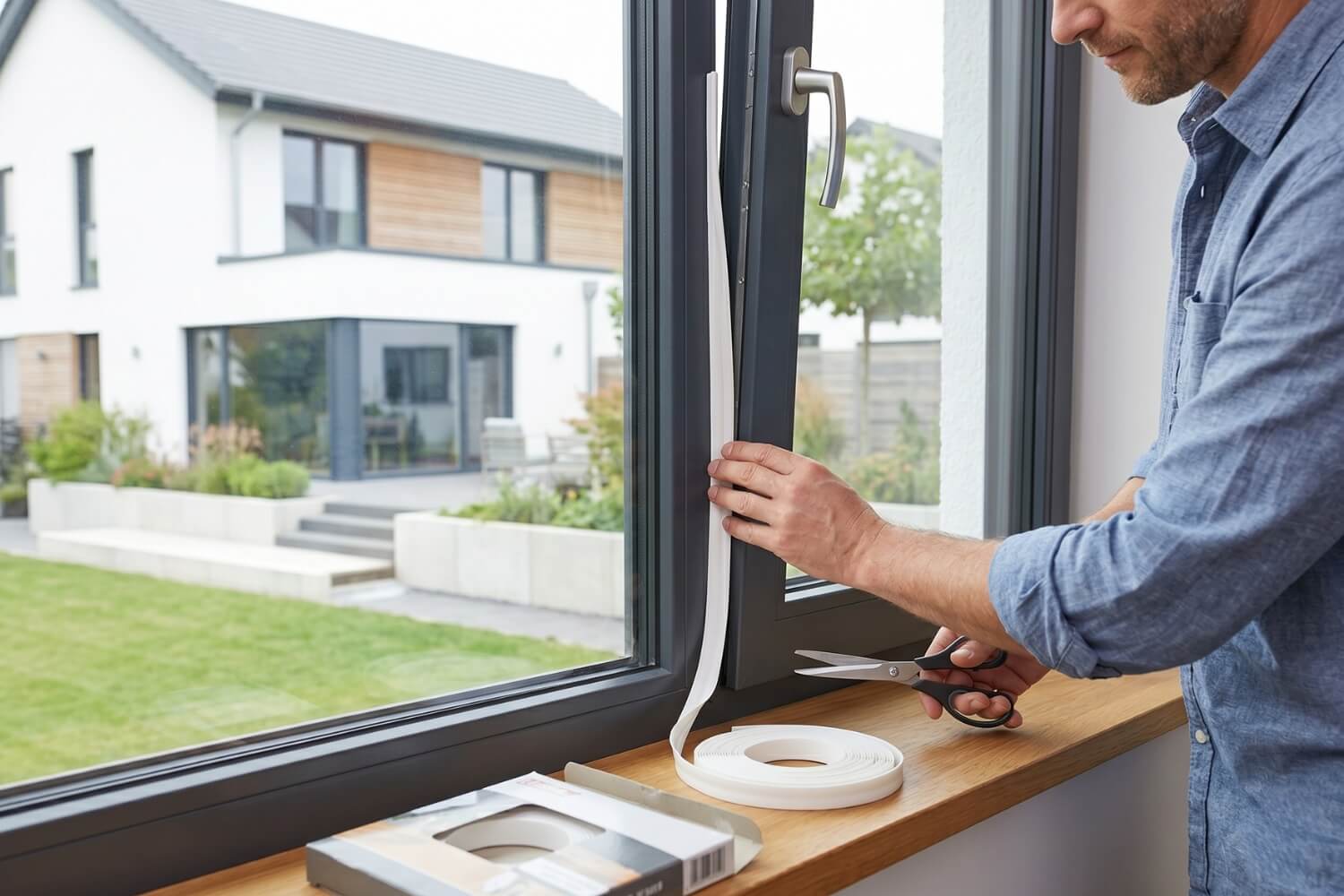
To replace weatherstripping: Pull off the old strip completely, clean the channel with a dry cloth, cut the new V-strip to length with scissors, and press it firmly into the channel with the open side of the V facing outside so it compresses when the window closes. Do a paper test to verify the seal before finishing.
Caulking: where to use it and what type
Caulk goes on fixed surfaces — the junction between the window frame and the wall. Never caulk the perimeter of an operable sash (that’s what weatherstripping is for) and never block the weep holes at the bottom of the window frame (they drain condensation and keep the frame from rotting).
For exterior use: 100% silicone caulk or a paintable siliconized latex. Pure silicone is more durable and flexible through freeze-thaw cycles, but it can’t be painted. Siliconized latex can be painted and is nearly as durable. Don’t use plain latex caulk on exteriors — it cracks in Canadian winters.
For interior use: Any paintable latex caulk. Fill the gap between the window casing and the drywall, and between the casing and the window frame. These gaps are usually small but they allow conditioned air to leak into the wall cavity.
Application tips: Cut the nozzle at a 45-degree angle, slightly smaller than the gap you’re filling. Apply in one continuous bead without stopping. Smooth immediately with a wet finger or a caulk tool. Let cure the full 24 to 48 hours before testing or painting.
When DIY Fixes Won’t Help
Heads up: The fixes above work when the window itself is sound. If any of the following apply, DIY repairs are a temporary patch at best. Get a professional assessment.
IGU seal failure: If you see condensation or fogging between the two panes of glass, the insulated glass unit’s edge seal has failed. Air and moisture are inside the unit. No amount of weatherstripping or caulking fixes this — the glass unit needs replacement.
Cracked or rotting frame: A cracked vinyl frame or a rotting wood frame has structural and air-sealing problems that can’t be patched. Replace the window.
Single-pane windows over 30 years old: If you’re still running single-pane windows, the heat loss through the glass itself dwarfs whatever you’d save by fixing the weatherstripping. Replacement is the right call here, and it will make a significant difference in your heating bills.
You’ve repaired it twice already: If you’ve replaced the weatherstripping and re-caulked the frame and the draft keeps coming back, there’s something structurally wrong with the window, the frame, or the rough opening. Time to call a pro and get a real diagnosis.
Frequently asked questions
How much does weatherstripping cost?
A basic kit for 5 to 6 windows runs $15 to $40. Professional weatherstripping replacement is $25 to $60 per window installed. Always worth trying before considering replacement.
What is the best caulk for windows?
For exterior use: 100% silicone or a paintable siliconized latex. Avoid plain latex caulk on exteriors — it cracks in cold weather. For interior trim gaps: any paintable latex caulk.
Should I use window film for drafts?
Window insulation film (the shrink-wrap kind) is a legitimate cheap fix for single-pane windows in older homes. It’s not pretty, but it works. On modern double-pane windows with a draft problem, it won’t help — fix the source instead.
How do I know if the draft is coming through the wall rather than the window?
Probe around the window frame where it meets the wall with a screwdriver. If you find gaps or missing insulation in the wall cavity, that’s your source. This requires more than caulk — fill the cavity with foam backer rod first, then caulk over it.
When is it actually time to replace instead of repair?
Replace when: the IGU has failed (foggy between panes), the frame is cracked or warped, the window is single-pane, or you’ve already repaired it twice and the draft keeps coming back.
Keep reading
If you’ve run through these fixes and still can’t get the draft under control, there may be a bigger issue with the window or the rough opening. NorthShield offers free in-home assessments in Winnipeg, Calgary, and Toronto. We’ll tell you whether a repair or replacement makes more sense for your specific situation. Book your free assessment today.
NorthShield Windows and Doors serves homeowners across Canada
Get a free quote for your project