

Knowing the real signs windows need replacing can save you thousands. Most homeowners either schedule window replacement in Toronto or Winnipeg years too early because a salesperson scared them, or they keep failing windows too long and pay for it in heating bills and comfort. I’ve assessed thousands of window installations in Winnipeg and across the prairies over 18 years. Here’s what actually matters.
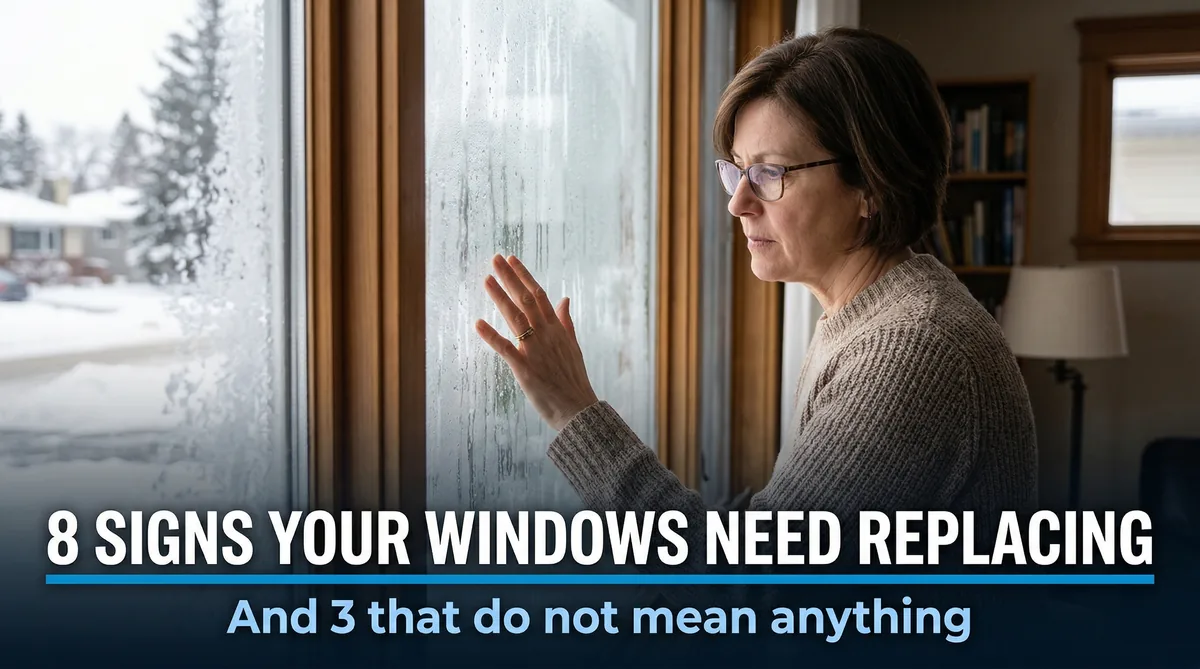
8 signs your windows genuinely need replacing
1. Condensation between the panes
This is the most definitive failure sign. When you see fog, moisture, or a milky film between the two panes of glass, the insulated glass unit (IGU) seal has failed. Air and humidity have gotten into the sealed space, and the argon or krypton gas that provides thermal resistance has escaped. The window is no longer insulating properly. This cannot be fixed with cleaning or caulking. The IGU needs to be replaced, and in most cases it makes more sense to replace the whole window.

2. You can feel cold radiating from closed windows
Stand about six inches from a closed window during winter. If you feel a column of cold air descending from the glass, the thermal performance of that window is compromised. On a well-performing double-pane window, the interior glass surface temperature should be within 2 to 3 degrees of your room temperature. If it feels cold to the touch or you can feel cold from a distance, the IGU has likely failed or the window was never well-insulated to begin with.
3. Visible rot, warping, or cracked frames
Wood frames rot from the inside out. By the time you see visible rot on the exterior surface, the interior of the frame is usually in worse shape. Press a screwdriver gently against soft-looking wood areas. If it goes in easily, the frame is compromised. Vinyl frames can crack in extreme cold if the PVC compound used during manufacturing is low quality. A cracked frame defeats any thermal performance claims and can also allow water infiltration into your wall assembly.
4. Difficulty opening, closing, or locking
This is more than a convenience issue. A window that doesn’t lock properly is a security concern, and a casement or awning window that won’t fully close is leaking air every time the wind picks up. Some hardware issues are adjustable, but when the mechanism itself won’t engage because the frame has shifted or warped, replacement is the right answer. Try adjusting the hardware first. If the frame won’t square up, the window is done.
5. Your energy bills have climbed year over year
Windows account for 25 to 30% of a home’s heat loss. If your heating costs have increased without a corresponding change in weather patterns or heating system performance, window degradation is worth investigating. Check all the other signs on this list. If two or more apply, failing windows are likely contributing to your bills.
6. Outside noise is noticeably louder than it used to be
This surprises some homeowners, but thermal performance and acoustic performance degrade together. When the IGU seal fails, the gas fill escapes and is replaced by regular air. The two panes of glass then vibrate more freely together, reducing sound insulation. If your home suddenly seems louder without obvious external changes, check for condensation between the panes.
7. You can see daylight around the frame
A serious air leak. At night, have someone stand outside with a bright flashlight while you watch from inside with the room lights off. Any light visible around the window frame means air is moving through that gap. This adds directly to your heating bill and can cause moisture damage to the surrounding wall framing over time.
8. Windows are single-pane or original to a pre-1990 house
Single-pane windows have an R-value of roughly R-1. A well-insulated exterior wall is R-20 or better. The window is easily the weakest point in your building envelope. Even basic double-pane ENERGY STAR certified windows deliver R-3 to R-4, and quality triple-pane units reach R-5 to R-7. If your home still has the original windows from 1985 or earlier, the payback on replacement is almost always there.
Three Signs that Look Bad but Don’t Mean Replacement
1. Condensation on the interior glass surface
This confuses a lot of homeowners because it looks similar to failed IGU condensation. The difference: interior surface condensation forms on the room-facing side of the glass and wipes off. It happens when indoor humidity is high and the glass surface is cold. The fix is improving your home’s ventilation, not replacing the windows. Run your HRV or bathroom fans more often, reduce humidifier output in shoulder seasons, and make sure your kitchen exhaust is actually venting outside.
2. Paint or caulking peeling around the frame
This is maintenance, not failure. Exterior caulking has a typical lifespan of 7 to 10 years before it starts cracking and separating. Scrape the old caulking, clean the surface, apply a quality exterior siliconized acrylic caulk, and you’ve resolved the issue. Same goes for peeling paint on wood trim. Don’t let a salesperson use peeling exterior trim to convince you that you need new windows.
3. A draft from one corner of one window
Before assuming the window is done, check the weatherstripping. Most casement and double-hung windows use a foam or pile weatherstrip that compresses over time and loses its seal. Replacement weatherstripping costs $20 to $60 and takes 20 minutes. If a new weatherstrip solves the problem, you’ve just saved yourself a $600 window replacement.

How to Do a Quick Window Inspection Yourself
Run through this five-step check on every window in your home. It takes about five minutes per window and will tell you clearly which ones need attention.
- Candle or incense test. Light a candle or incense stick and hold it near the frame edges, sash edges, and corners. Watch for smoke deflection. Any movement means air infiltration. Safety Note: Exercise extreme caution when using an open flame near curtains, blinds, or window frames. Always keep a fire extinguisher nearby and never leave a lit candle or incense stick unattended during testing.
- Visual frame check. Look for visible cracks, rot, discolouration, or separation at the frame corners. Press gently on any soft-looking areas. Pay particular attention to the bottom corners where water tends to collect.
- Condensation check. Look between the panes from an angle in bright light. Any fog, milkiness, or visible moisture means IGU seal failure.
- Lock and operation test. Open and close every sash. Operate every lock and latch. Anything that won’t operate smoothly or doesn’t close firmly deserves closer attention.
- Cold radiation test. On a cold day, hold your hand 15 cm from the closed glass. A properly functioning double-pane window should feel close to room temperature. Significant cold radiation means thermal failure.

Repair vs Replace: The Honest Calculus
Single repairs under $200 usually make sense. Weatherstripping, hardware replacement, recaulking, exterior trim repair: these are maintenance items and doing them extends window life. If you’re dealing with a failed IGU seal on a window that is otherwise structurally sound and less than 15 years old, replacing just the glass unit can be a legitimate option. A glazier can supply and install a new IGU for $150 to $350 per window.
But if you have an older frame with multiple issues, if the frame has shifted, if you have rot, or if the window is part of a batch where several are failing simultaneously, full replacement makes more financial sense. You won’t get better IGU longevity out of a compromised frame, and you won’t recover the performance gap that older frame profiles carry compared to modern ones.
Frequently asked questions
How old should windows be before replacing?
Age alone is not the deciding factor. A 25-year-old window that still seals well beats a 10-year-old low-quality replacement. Assess by performance, not age. Look for condensation between panes, drafts, or difficulty operating as your actual indicators of replacement need.
Can a failed window seal be repaired?
Technically yes – a glazier can replace just the glass unit (IGU). But if the frame is 20 or more years old, replacing the whole window usually makes more sense economically. A new IGU in an old frame often fails faster than expected because the frame itself no longer provides a stable seal environment.
What is the lifespan of vinyl windows in Canada?
Quality vinyl windows last 20 to 30 years in Canadian climates. Cold-weather cycling and UV exposure are the main failure modes. The insulated glass unit typically fails before the frame does, showing as fog or condensation between the panes. This can happen as early as 10 to 15 years in low-quality units.
Do I need to replace all windows at once?
No. Replace the worst performers first. Prioritize north-facing and west-facing windows in cold climates – they take the most punishment from cold temperatures and wind. South-facing windows often last longer because solar gain keeps the glass warmer and slows IGU seal degradation.
How do I know if my windows are ENERGY STAR certified?
Look for the ENERGY STAR label in the corner of the glass or on the frame. Or check the paperwork from when they were installed. If you can’t find any documentation and the windows are from before 2000, they almost certainly aren’t certified. Windows manufactured before the 1990s won’t meet any modern efficiency standard.
If you found two or more signs on this list in your home, it’s worth having a professional take a look. NorthShield offers free window assessments in Winnipeg, Toronto, and Calgary. We’ll tell you honestly what needs replacing and what can wait. Book your free assessment here.
NorthShield Windows and Doors serves homeowners across Canada
Get a free quote for your project